
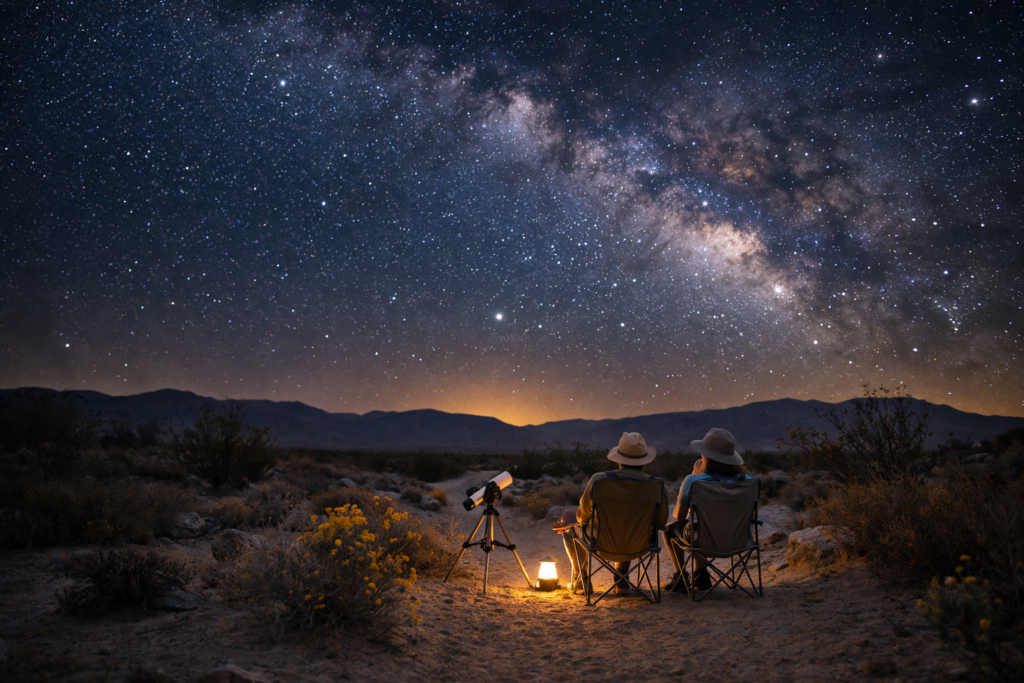
On a clear night in the desert, far from the glow of city lights, the sky transforms into something most people have never seen — a dome of stars so dense it looks painted, bisected by the luminous arc of the Milky Way stretching horizon to horizon. This desert stargazing guide is your complete resource for planning a night under the darkest skies in the American Southwest, from choosing the right location and timing your visit around celestial events to packing the right gear and understanding what you’re looking at once you tilt your head back. Whether you’re a first-timer chasing the Milky Way or an experienced astrophotographer scouting your next dark-sky destination, everything you need starts here.
Why the Desert Is the Best Place to Stargaze
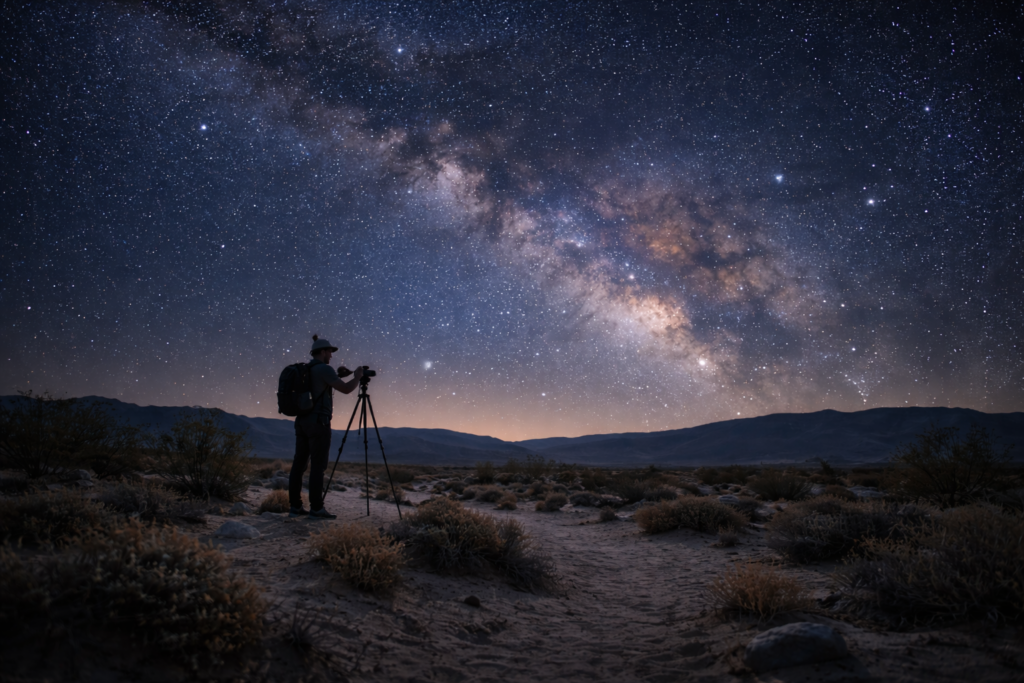
Not all dark skies are equal. Deserts consistently outperform forests, mountains, and coastlines for astronomical observation, and the reasons are rooted in atmospheric science.
Minimal light pollution. The vast, sparsely populated expanses of the American desert create enormous buffers between observers and urban light domes. A location like Anza-Borrego Desert State Park sits more than 60 miles from the nearest major metro area, producing Bortle Class 2 skies — dark enough to see the zodiacal light, the gegenschein, and star clouds in Sagittarius with the unaided eye.
Low humidity and atmospheric moisture. Desert air holds a fraction of the water vapor found in coastal or forested environments. Water vapor scatters light, dims faint objects, and reduces contrast. The arid conditions of the Mojave, Sonoran, and Chihuahuan deserts yield exceptional atmospheric transparency that makes stars appear sharper and more numerous.
High percentage of clear nights. The southwestern U.S. desert averages 200 to 300 clear nights per year, compared to 100 to 150 for the Pacific Northwest or the upper Midwest. This dramatically increases the odds that any given trip will deliver ideal viewing conditions.
Stable atmospheric seeing. Desert locations away from mountain ridgelines often experience laminar (smooth) airflow at night, reducing the atmospheric turbulence that causes stars to twinkle and planets to shimmer. Steady seeing is critical for telescopic observation and astrophotography.
These four factors combine to make the desert the most reliable environment on the continent for world-class stargazing.
Best Desert Stargazing Locations in the U.S.
The International Dark-Sky Association (IDA) has certified dozens of parks and communities across the American desert as International Dark Sky Places. These locations meet rigorous standards for light pollution control and public access. The following destinations represent the finest dark-sky experiences available.
Anza-Borrego Desert State Park, California
California’s largest state park encompasses over 600,000 acres of protected desert wilderness and holds an IDA International Dark Sky Park designation. The community of Borrego Springs — surrounded entirely by parkland — is one of only two International Dark Sky Communities in California. Bortle Class 2 skies are regularly measured at popular observation points like Font’s Point and the Borrego Palm Canyon overflow lot.
Big Bend National Park, Texas
Located in the remote Chihuahuan Desert along the Rio Grande, Big Bend is one of the least light-polluted national parks in the lower 48 states. The park’s Bortle Class 1 and 2 zones — the darkest classification measurable — support naked-eye views of over 2,000 stars and visual detection of the Andromeda Galaxy as a distinct fuzzy patch.
Death Valley National Park, California/Nevada
Death Valley’s extreme remoteness and basin-and-range topography shield observers from distant city lights. The Mesquite Flat Dunes and Harmony Borax Works areas offer iconic foreground elements for astrophotography beneath some of the darkest skies in North America.
Natural Bridges National Monument, Utah
The world’s first IDA-certified International Dark Sky Park, Natural Bridges consistently records Bortle Class 2 readings. The combination of natural stone arches and a pristine sky makes this a bucket-list destination for night-sky photographers.
Joshua Tree National Park, California
While its western boundary experiences some light dome from the Coachella Valley, Joshua Tree’s backcountry — particularly around Keys View and Jumbo Rocks — delivers Bortle Class 3 to 4 skies. The park’s proximity to Los Angeles and San Diego makes it one of the most accessible dark-sky destinations for urban stargazers.
Cosmic Campground, New Mexico
Designated as the first International Dark Sky Sanctuary in the Northern Hemisphere, Cosmic Campground in the Gila National Forest is surrounded by millions of acres of uninhabited wilderness. Its Bortle Class 1 skies are among the darkest measured anywhere in the United States.
When to Go: Timing Your Desert Stargazing Trip
Choosing the right date is just as important as choosing the right location. Three variables determine sky quality on any given night.
Moon phase. The single most important factor. A full moon washes out all but the brightest stars and completely obscures the Milky Way. Plan your trip within five days of a new moon for the darkest conditions. Astronomical calendars and apps like Stellarium, PhotoPills, and The Photographer’s Ephemeris display moon phase and rise/set times for any date and location.
Milky Way visibility window. The galactic core — the brightest, most photogenic section of the Milky Way — is visible in the Northern Hemisphere from approximately late March through early October. It rises in the southeast after midnight in spring, arcs high overhead during summer, and sets in the southwest by early evening in fall. June through August offers the longest core visibility window, aligning conveniently with warm desert nights.
Meteor shower peaks. Major annual meteor showers provide extraordinary viewing in dark desert skies. The Perseids in mid-August produce 50 to 100 meteors per hour at peak under ideal conditions. The Geminids in mid-December rival the Perseids in intensity and occur during the desert’s cooler, drier season. The Quadrantids in early January and the Eta Aquariids in early May are also strong performers. Cross-reference each shower’s peak date with the moon phase calendar — a meteor shower that peaks during a full moon is dramatically diminished.
Seasonal weather patterns. The southwestern desert’s dry season — roughly October through May — offers the highest probability of clear skies. Summer months bring the North American monsoon to parts of Arizona, New Mexico, and southeastern California, introducing afternoon thunderstorms that may or may not clear by nightfall. Check satellite cloud cover forecasts on Clear Outside or the National Weather Service before committing to a drive.
Essential Gear for Desert Stargazing
You don’t need expensive equipment to have a transformative night under the stars. But the right preparation makes the difference between a comfortable, rewarding experience and a cold, frustrating one.
Red-light headlamp. White light destroys your night-adapted vision — called dark adaptation — which takes 20 to 30 minutes to fully develop. A headlamp with a red-light mode preserves your ability to see faint stars and nebulae while letting you navigate safely. If your headlamp lacks a red mode, cover the lens with red cellophane or tape.
Warm layers. Desert temperatures drop sharply after sunset. A location that reaches 95°F during the day can fall to 50°F or lower by midnight, especially at elevation. Bring a down or synthetic insulated jacket, warm hat, gloves, and a compact camp blanket or sleeping bag to wrap in during extended viewing sessions.
Reclining camp chair or ground pad. Craning your neck upward for extended periods causes rapid fatigue. A zero-gravity reclining chair or a foam sleeping pad lets you observe comfortably in a reclined position for hours.
Star chart or night-sky app. A planisphere (rotating star chart) works without batteries or screen glare. Apps like Stellarium, Sky Safari, and Star Walk offer real-time augmented-reality overlays when held against the sky — use them in night mode to minimize screen brightness.
Binoculars. A quality pair of 7×50 or 10×50 binoculars reveals dramatically more than the naked eye — star clusters like the Pleiades resolve into individual stars, the Orion Nebula shows its gaseous structure, and Jupiter’s four largest moons become visible as tiny points of light. Binoculars are lighter, cheaper, and easier to use than a telescope, making them the single best optic upgrade for a casual stargazer.
Telescope (optional). If you own a portable telescope, the desert is where it performs best. An 8-inch Dobsonian reflector — the most popular choice for visual astronomy — reveals Saturn’s rings, the cloud bands of Jupiter, hundreds of deep-sky objects, and lunar detail sharp enough to resolve individual crater walls. For first-time telescope buyers, expect to invest $300 to $600 for a quality starter instrument.
What to Look for in the Desert Night Sky
Once your eyes have adjusted to the dark — allow a full 20 to 30 minutes without any white light exposure — the sky reveals layers of detail invisible from light-polluted areas.
The Milky Way. Under Bortle Class 2 or 3 skies, the Milky Way appears as a luminous, textured band with visible dark lanes of interstellar dust. The galactic core in Sagittarius looks like a dense, glowing cloud — because it is. You’re looking toward the center of a barred spiral galaxy containing an estimated 100 to 400 billion stars.
Planets. Venus, Jupiter, Mars, and Saturn are all visible to the naked eye and dramatically brighter than any star. Their positions change month to month — use a sky app to identify which planets are above the horizon on your viewing night.
Andromeda Galaxy (M31). The nearest large galaxy to our own, located 2.5 million light-years away, is visible as a faint elongated smudge in the constellation Andromeda during autumn and winter. In dark desert skies, it spans a patch of sky roughly six times the apparent diameter of the full moon.
Satellites and the International Space Station. Low-Earth orbit satellites appear as steady points of light moving smoothly across the sky. The ISS is the brightest, rivaling Venus in luminosity during favorable passes. Use the Heavens-Above app or NASA’s Spot the Station tracker to predict visible passes for your location.
Zodiacal light. Visible only from very dark sites, this faint, triangular glow appears along the ecliptic after evening twilight (in spring) or before morning twilight (in autumn). It is caused by sunlight scattering off interplanetary dust in the plane of the solar system — a phenomenon most people will never see from an urban or suburban location.
Desert Stargazing Safety Tips
The same remoteness that creates dark skies also introduces hazards. Prepare accordingly.
Stay on established roads and trails when driving to your observation point. Desert terrain is deceptive at night, and vehicles can become stuck in soft sand or washes. Carry a basic recovery kit, a full-size spare tire, and extra water. Tell someone your planned location and expected return time — cell service is unavailable in most prime stargazing areas. Watch for nocturnal wildlife, especially rattlesnakes, which are active on warm desert surfaces after dark. Scan the ground with your red headlamp before setting down a chair or blanket. Never stargaze in a dry wash — flash floods can occur with no local rainfall.
Frequently Asked Questions
What is the best month for desert stargazing?
For Milky Way viewing, June through August delivers the longest galactic core visibility and the warmest overnight temperatures. For overall sky clarity, meteor showers, and comfortable conditions, October through December is exceptional — the Geminid meteor shower in mid-December is widely considered the best annual meteor event and coincides with the desert’s dry season. New moon weekends in any month between October and April offer outstanding conditions.
Can I see the Milky Way with the naked eye in the desert?
Yes — and it is the primary reason most people travel to dark-sky desert locations. Under Bortle Class 2 or 3 conditions, the Milky Way is unmistakable: a bright, textured band stretching across the entire sky with visible structure, dark dust lanes, and a brilliant core region. You do not need a telescope, binoculars, or any optical aid. You need only a dark site, a moonless night, and 20 to 30 minutes of dark adaptation.
Do I need a telescope to enjoy desert stargazing?
Not at all. The naked-eye experience in a truly dark desert location surpasses what most people see through a telescope in a light-polluted city. Thousands of stars, the Milky Way, visible planets, meteor showers, satellites, and even the Andromeda Galaxy are all accessible without equipment. Binoculars significantly enhance the experience for a modest investment. A telescope adds another layer of depth but is entirely optional for a rewarding night.
Is desert stargazing safe for families with children?
Desert stargazing is a wonderful family activity with proper preparation. Choose an accessible site near a paved road, such as a campground or designated viewing area, rather than a remote backcountry location. Bring warm clothing in layers, hot cocoa in a thermos, and a reclining chair or blanket for each family member. A night-sky app on a phone set to red-screen mode makes identifying constellations interactive and engaging for children. Plan to arrive at sunset so kids can watch the sky transition from daylight to full darkness — that progression is part of the magic.
How dark does the sky need to be to see the Milky Way?
The Milky Way becomes visible at approximately Bortle Class 4 — a rural/suburban transition zone where the sky is noticeably darker than suburban areas but still shows some light domes on the horizon. For a truly dramatic, fully structured Milky Way with a visible galactic core, you need Bortle Class 3 or darker. Most of the desert locations listed in this guide regularly achieve Bortle Class 2 to 3 conditions, which is sufficient to see astronomical detail that rivals observatory-grade urban views.
What is the Bortle Scale?
The Bortle Scale is a nine-level numeric scale that measures the darkness of the night sky at a given location. Class 1 represents the darkest skies on Earth — found only in the most remote locations — and Class 9 represents the bright inner-city sky where only the moon, planets, and a handful of stars are visible. Most of the recommended desert stargazing locations in this guide fall between Bortle Class 1 and Class 3, where the Milky Way casts visible shadows and thousands of stars are visible to the naked eye.
Plan Your Night Under the Stars
The desert doesn’t charge admission. There is no ticketed event, no reservation window, no crowd to fight. There is only you, the silence, and a sky that has looked exactly this way for thousands of years — a sky that most people alive today have never actually seen.
Choose your destination from the locations above. Check the moon phase calendar and pick a new moon weekend. Pack your layers, your red headlamp, and your reclining chair. Drive until the city glow fades from the rearview mirror and the first stars begin to sharpen overhead.
If you’re planning a trip to Anza-Borrego, Death Valley, Big Bend, or any of the desert dark-sky destinations in this guide, book accommodations early — new moon weekends during peak season fill fast, especially at campgrounds adjacent to prime viewing sites. Download offline maps and a night-sky app before you leave cell range. And give yourself more time than you think you need. The best moments under a desert sky always happen after you’ve stopped checking the clock.
The stars are already there. You just have to show up.